Breaking News




Popular News





Enter your email address below and subscribe to our newsletter
 By Mohit Kumar Nirwan
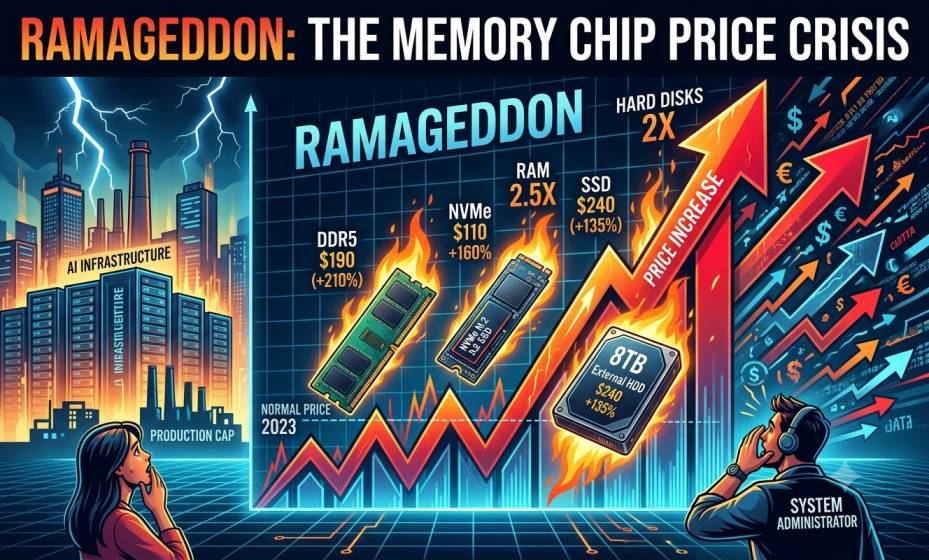
The global technology market is experiencing a severe component cost surge, dubbed "RAMageddon" by industry insiders. Consumer and enterprise memory hardware—including system RAM (DDR4/DDR5), solid-state drives (SSDs), high-capacity external hard drives, and mobile storage—have seen retail prices double, with specific high-density modules spiking 200% to 300% (a 3-fold increase).
SSDs (NVMe & SATA): NAND flash wafer spot prices surged nearly 8.5 times. Standard 1TB NVMe drives that hovered around $45–$50 during market bottoms have jumped past $90–$110, while high-capacity 4TB to 8TB consumer drives have more than doubled in price.
System RAM (DRAM): Standard DDR5 kits have seen 80% to 90%+ quarter-over-quarter spikes. Multi-channel enthusiast kits (32GB/64GB) have taken the brunt of the increase as chipmakers prioritize enterprise customers.
External & Internal Hard Drives (HDDs): High-capacity mechanical drives have increased 45% to 50%+. Major suppliers like Western Digital have reported being fully booked and sold out for enterprise capacity well in advance.
Artificial Intelligence datacenters are consuming vast amounts of hardware.
Cleanroom and wafer fabrication space is physically limited.
Following a severe memory oversupply in 2022–2023, major manufacturers intentionally slashed output to prevent price drops. When AI-driven demand rapidly expanded, factories could not ramp production back up quickly enough to meet the gap.
Recognizing this structural shift, major brands have begun deprioritizing consumer retail lines. Micron sunset its long-running Crucial consumer brand to redirect 100% of its memory output to higher-margin enterprise and cloud clients.
Market intelligence firms (such as TrendForce, IDC, and Counterpoint Research) indicate that a quick drop back to historic low pricing is unlikely in the short term.
Short-Term (Late 2026): Prices are expected to remain elevated or undergo minor fluctuations.
Mid-Term (2027 Horizon): A realistic period for market stabilization is projected for 2027. Semiconductor giants are increasing capital expenditure (Capex) by hundreds of billions of dollars to build new fabrication facilities (fabs).
The "New Normal" Baseline: Analysts caution that consumer memory may not return to the extreme lows of mid-2023. The baseline floor for storage and RAM pricing has structurally reset higher due to persistent AI computing demand and increased base manufacturing costs.