Breaking News




Popular News




Enter your email address below and subscribe to our newsletter
 By Muhd Usman
Choosing the right technology stack is one of the most important decisions a startup makes during the early stages of product development. The technologies selected for building a web or mobile application can affect its performance, scalability, development cost, security, and long-term maintenance.
With hundreds of programming languages, frameworks, databases, and cloud platforms available today, choosing the right combination can be challenging. Startups should focus not on selecting the most popular technology, but on selecting technologies that align with their product requirements and business goals.
A technology stack is the combination of technologies used to build and run a software application.
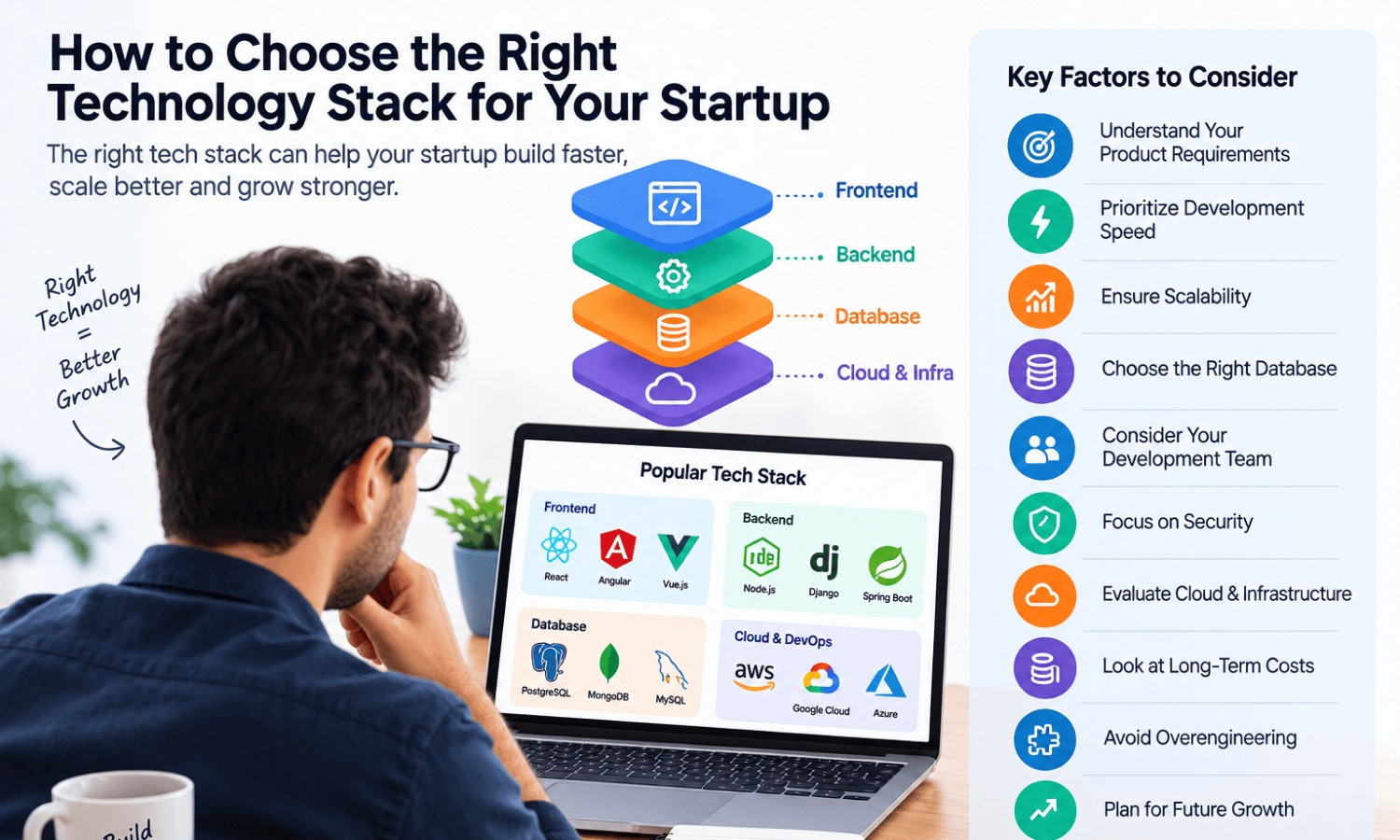
A typical technology stack consists of several layers, including:
Frontend: The part of an application users interact with.
Backend: The server-side logic that processes requests and manages business operations.
Database: The system used to store and manage application data.
APIs: Interfaces that allow different applications and services to communicate.
Cloud and Infrastructure: Services used for hosting, deployment, storage, monitoring, and scaling.
For example, a startup might choose React for the frontend, Node.js and Express for the backend, PostgreSQL for the database, and AWS for cloud infrastructure.
Before choosing technologies, clearly understand what you are building.
Ask questions such as:
What problem does the product solve?
Who are the target users?
Is it a web application, mobile application, or both?
What features are required?
How much traffic is expected initially?
Will the application need real-time communication?
Does it require payments, maps, video, or AI?
What level of security is required?
The technology stack should be selected based on these requirements rather than choosing technologies simply because they are trending.
Startups often need to validate their ideas quickly. Building a Minimum Viable Product (MVP) allows a startup to test its product with real users before investing heavily in development.
Technologies with mature frameworks, libraries, documentation, and development tools can help teams build features faster.
For example, frameworks such as React, Next.js, Django, Spring Boot, and Laravel provide established tools and ecosystems that can accelerate development.
However, development speed should not come at the expense of code quality, security, or maintainability.
A startup may begin with a small number of users but could potentially grow significantly over time.
Therefore, the selected technology stack should be capable of handling increasing:
Users
API requests
Database operations
Storage requirements
Background jobs
Concurrent connections
Scalability does not necessarily mean starting with a complex microservices architecture. For many startups, a well-designed monolithic application can be an effective starting point.
As the product grows, parts of the system can be separated into independent services when there is a clear technical or business reason to do so.
The database is another critical part of the technology stack.
Two common categories are:
Examples include PostgreSQL and MySQL.
They are useful when an application requires structured data, relationships between entities, transactions, and strong consistency.
Common use cases include:
Banking systems
E-commerce platforms
Accounting applications
Enterprise software
Examples include MongoDB, DynamoDB, and other document or key-value databases.
They can be useful for applications that require flexible data structures, high scalability, or specific access patterns.
The right choice depends on the application's data model and requirements rather than simply choosing whichever database is currently popular.
The skills of your development team should strongly influence your technology decisions.
If your developers already have extensive experience with JavaScript, choosing a JavaScript-based stack may allow the team to develop and maintain the product more efficiently.
For example, a team experienced in the MERN stack may use:
MongoDB
Express.js
React
Node.js
On the other hand, a team experienced in Java may prefer technologies such as Spring Boot and PostgreSQL.
Choosing technologies that match the team's expertise can reduce the learning curve and development risk.
A strong ecosystem can make development and maintenance significantly easier.
Before adopting a technology, consider:
Documentation quality
Community support
Available libraries
Third-party integrations
Developer availability
Frequency of updates
Long-term adoption
A technology with a large and active ecosystem can make it easier to find solutions when developers encounter technical challenges.
Security should be considered from the beginning of development rather than added as an afterthought.
Depending on the application, security considerations may include:
Authentication and authorization
Secure password storage
API security
Input validation
Data encryption
Secure payment processing
Protection against common web vulnerabilities
Access control
Secure cloud configuration
The technology stack should provide the tools and capabilities necessary to implement appropriate security practices.
Modern applications commonly rely on cloud infrastructure for hosting, databases, storage, monitoring, and other services.
Platforms such as AWS, Microsoft Azure, and Google Cloud provide services that can help startups deploy and scale applications without managing all infrastructure themselves.
When selecting cloud services, consider:
Expected workload
Pricing
Availability
Scalability
Deployment requirements
Monitoring capabilities
Security features
Startups should avoid adopting unnecessary cloud services simply because they are available. Using only the services required by the product can keep infrastructure simpler and easier to manage.
Technology decisions affect more than the initial development budget.
A stack can create long-term costs related to:
Developer salaries
Cloud infrastructure
Third-party services
Software licenses
Maintenance
Security updates
Developer training
A technology that is inexpensive to start with may become expensive to maintain if it lacks a strong ecosystem or requires specialized developers.
Therefore, startups should consider the total cost of ownership, not just the initial development cost.
One of the most common mistakes startups make is building an overly complex architecture too early.
For example, a small application with a few thousand users may not require:
Multiple microservices
Complex event-driven architecture
Multiple databases
Large Kubernetes clusters
Extensive infrastructure automation
Complexity should be introduced when the product actually needs it.
A simple, well-structured architecture is often easier to develop, test, deploy, and maintain during the early stages of a startup.
Although startups should avoid unnecessary complexity, they should still make technology decisions with future growth in mind.
A good architecture should allow the team to gradually introduce:
Caching
Load balancing
Message queues
Background workers
Database optimization
Containerization
Microservices
Automated CI/CD pipelines
The objective is not to build the final architecture on day one, but to create a solid foundation that can evolve as the business grows.
Before committing to a technology stack, consider building a small proof of concept.
For example, if your application requires real-time communication, test whether your chosen backend technology can efficiently handle WebSocket connections.
If the product requires complex data analysis, test the database and processing architecture with realistic workloads.
Small experiments can reveal technical limitations before significant development resources are invested.
Consider a startup building an e-commerce platform.
A possible technology stack could include:
Frontend: React or Next.js
Mobile: React Native
Backend: Node.js with Express.js or NestJS
Database: PostgreSQL
Caching: Redis
Authentication: JWT or an appropriate managed identity solution
Storage: Cloud object storage
Deployment: Docker with a suitable cloud platform
CI/CD: GitHub Actions or another CI/CD platform
Monitoring: Cloud or application monitoring tools
This is only an example. The best stack will depend on the startup's specific requirements, team expertise, expected scale, budget, and product roadmap.
Choosing a technology stack is not about finding the newest or most popular technology. It is about finding the right combination of technologies for a specific product and business.
Startups should evaluate their product requirements, development team's skills, scalability needs, security requirements, development speed, ecosystem, infrastructure, and long-term maintenance costs before making a decision.
The best technology stack is one that helps the team build efficiently today while leaving enough flexibility to grow tomorrow.
By making technology decisions based on real requirements instead of trends, startups can reduce development risks, control costs, and create a stronger foundation for long-term growth.