Breaking News




Popular News





Enter your email address below and subscribe to our newsletter
 By Mohit Kumar Nirwan
Imagine waking up one morning to discover that government portals, public services and major websites across different countries have suddenly gone offline. The reason isn't a server failure or internet outage. It is a critical security vulnerability discovered in one of the world's most widely used programming languages: PHP.
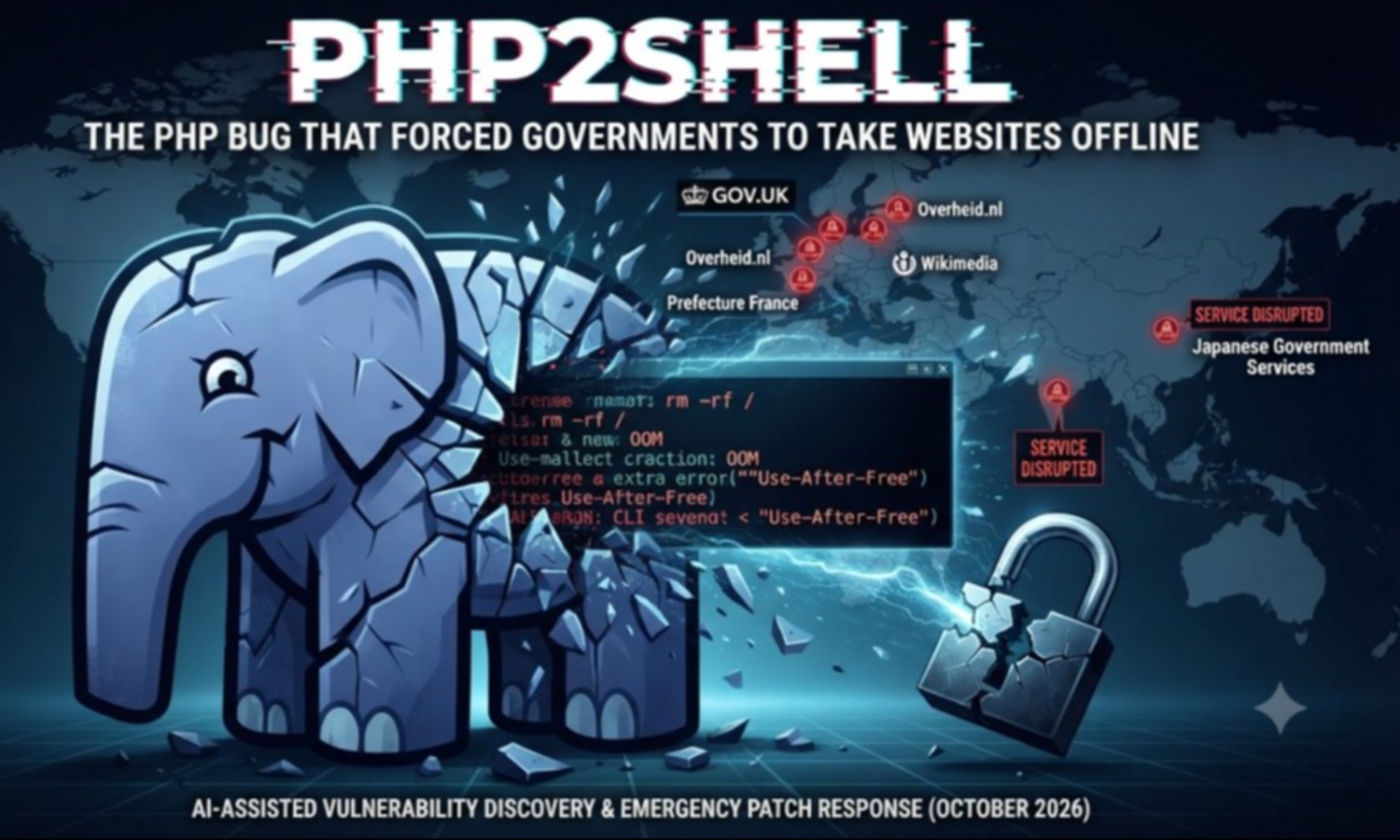
In October 2026, two serious vulnerabilities in PHP triggered an extraordinary cybersecurity response. Governments and cybersecurity agencies across several countries issued urgent advisories, asking organizations to update their PHP installations or temporarily take vulnerable websites offline.
On October 21, 2026, the PHP development team disclosed two critical security vulnerabilities:
CVE-2026-109618: A memory corruption vulnerability involving Out-of-Memory (OOM) conditions.
CVE-2026-109619: A Use-After-Free vulnerability involving PHP's internal memory management.
Both vulnerabilities received a CVSS v4.0 severity score of 9.2 out of 10.
The biggest concern was that attackers could potentially exploit these flaws without authentication and execute malicious code on affected servers. This meant that vulnerable websites could be compromised even without an attacker having a legitimate account.
1. Out-of-Memory (OOM) Vulnerability
PHP manages memory while processing incoming requests. A flaw in this process could cause PHP to mishandle incomplete internal data structures when memory was exhausted. Attackers could potentially exploit this memory corruption to execute arbitrary code on the server.
2. Use-After-Free Vulnerability
This occurs when a program tries to access memory that has already been released. In PHP, outdated references to internal request data could potentially remain accessible, allowing attackers to manipulate the application's memory and execute malicious commands.
Both vulnerabilities were particularly dangerous because successful exploitation could compromise the underlying server.
PHP powers millions of websites, applications and online services worldwide. As a result, the vulnerabilities created concerns far beyond individual website owners.
Following the disclosure, cybersecurity agencies in several countries issued urgent advisories recommending immediate security updates. Organizations that could not patch their systems quickly were advised to temporarily disable vulnerable services.
Some notable disruptions included:
Netherlands: Government portals, including Overheid.nl, along with hospital and port-related websites, were affected.
Finland: Government web services were temporarily shut down.
France: Several prefecture websites were taken offline.
Japan: Certain services belonging to government departments and agencies were temporarily suspended.
United Kingdom: The BBC and several local government websites experienced disruptions.
Germany and Canada: Authorities issued warnings and precautionary measures concerning vulnerable systems.
Wikimedia Foundation: The organization responsible for Wikipedia also took certain systems offline while addressing the vulnerabilities.
It is important to note that these shutdowns were primarily precautionary measures. They did not necessarily indicate that every affected organization had suffered a successful cyberattack.
An interesting aspect of this incident was the involvement of Artificial Intelligence in security research.
Researchers from organizations including Calif, Wiz, Quarkslab and OpenAI investigated PHP's internal behaviour as part of broader security research initiatives.
AI-assisted analysis helped researchers identify weaknesses, investigate potential exploitation methods and understand the severity of the vulnerabilities.
The incident demonstrated how AI is becoming an increasingly important tool in cybersecurity, helping researchers discover software vulnerabilities that might otherwise remain unnoticed.
The PHP development team released emergency security updates on October 21, 2026.
The patched versions included:
PHP 8.5.12
PHP 8.4.27
PHP 8.3.36
PHP 8.2.35
Organizations were advised to upgrade immediately, identify all potentially affected systems and investigate suspicious server activity. Temporary mitigation measures were also provided for environments where immediate updates were not possible.
The PHP2Shell incident highlights several important cybersecurity lessons:
Keep software updated: Always install security patches as soon as they become available.
Monitor dependencies: Third-party applications and plugins may introduce vulnerabilities even when your own code is secure.
Monitor server activity: Look for suspicious requests, unexpected processes and unauthorized file modifications.
Prepare for emergencies: Organizations should have a plan for isolating vulnerable systems and restoring services safely.
Never ignore infrastructure security: Application-level security alone cannot protect a website if its underlying technology is vulnerable.
The PHP2Shell incident demonstrated how a vulnerability in a single programming language could disrupt digital services across multiple countries.
It also highlighted the growing role of AI in identifying security weaknesses and the importance of responding quickly to critical vulnerabilities.
The biggest takeaway is simple: No software is completely secure, regardless of how widely it is used or how long it has existed. Regular updates, continuous monitoring and timely security responses are essential to protecting the digital world.
References:
PHP Official Security Advisories
UK National Cyber Security Centre (NCSC)
Singapore Cyber Security Agency (CSA)
Cloudflare Security Analysis
Reuters Coverage of the PHP2Shell Incident