Breaking News




Popular News





Enter your email address below and subscribe to our newsletter
 By Mohit Kumar Nirwan
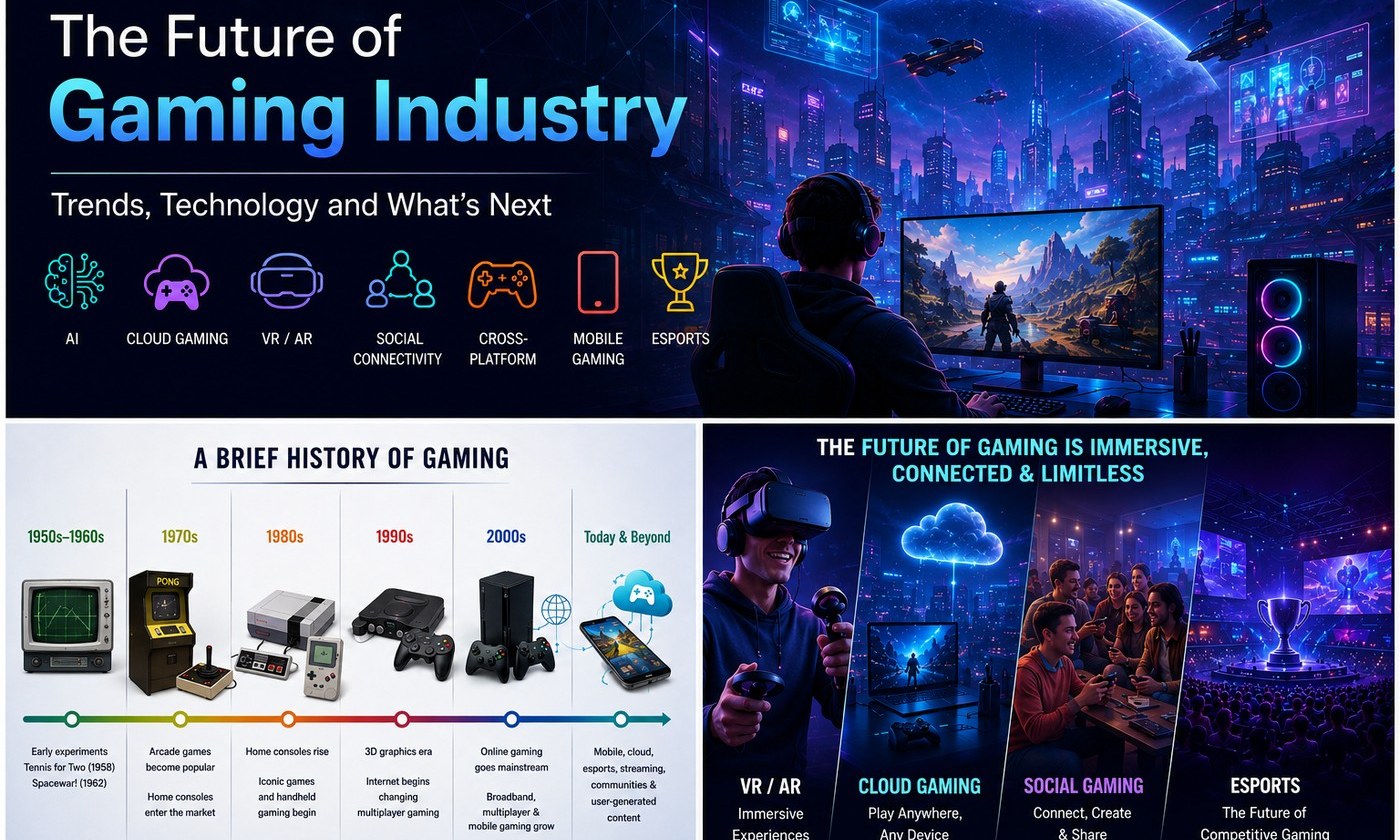
The gaming industry has transformed dramatically over the past few decades. What started with simple arcade games and basic computer experiments has become one of the world's largest entertainment industries.
Today, gaming is no longer limited to consoles and PCs. People play games on smartphones, tablets, handheld devices and smart TVs, while online multiplayer, esports, streaming and digital communities have made gaming a highly social experience.
New technologies such as Artificial Intelligence (AI), Virtual Reality (VR), Augmented Reality (AR), cloud gaming and faster internet connectivity are now shaping the next generation of games.
The future of gaming isn't simply about better graphics. It is about creating games that are more immersive, intelligent, personalized and connected.
A Brief History of the Gaming Industry
The origins of video games can be traced back to the 1950s and 1960s, when researchers began experimenting with interactive computer programs. One important milestone was Tennis for Two, created in 1958, followed by Spacewar! in 1962.
The 1970s marked the beginning of commercial gaming. Arcade games such as Pong became popular, while the Magnavox Odyssey introduced gaming into homes.
During the 1980s, home consoles became increasingly popular. Nintendo's NES helped establish iconic franchises such as Super Mario Bros. and The Legend of Zelda. Handheld gaming also became popular with the launch of the Game Boy in 1989.
The 1990s introduced more powerful 3D graphics and popular consoles such as the PlayStation and Nintendo 64. Internet connectivity also started changing multiplayer gaming.
During the 2000s, broadband internet, online console services and multiplayer games became mainstream. Then smartphones opened gaming to an even larger audience.
Today, gaming has evolved into a global ecosystem involving mobile gaming, cloud gaming, esports, streaming, online communities and user-generated content.
The future of gaming industry
1. Artificial Intelligence will change game development
AI is expected to play a major role in the future of gaming. Developers can use AI to assist with programming, testing, character behavior, storytelling and content creation.
Future games could feature NPCs that communicate naturally with players, dynamically generated missions and game worlds that respond to individual playing styles.
AI could also personalize the experience by automatically adjusting difficulty, enemies, rewards and story progression.
However, the industry will need to address concerns surrounding copyright, originality and the responsible use of AI-generated content.
2. Cloud gaming will make games more accessible
Cloud gaming allows games to be processed on remote servers and streamed to devices over the internet.
This could reduce the need for expensive gaming hardware. In the future, players may be able to access high-quality games from smartphones, laptops, tablets and smart TVs.
The biggest challenge will be internet connectivity. Stable, high-speed networks and low latency will be essential for a smooth cloud gaming experience.
3. AR/VR will create more immersive experiences
Virtual and augmented reality could change how players interact with games.
Instead of simply watching a character on a screen, players could feel as though they are actually inside the game world.
Future applications could include:
As VR and AR hardware becomes lighter and more affordable, these technologies could become much more common.
4. Gaming will become more social
Gaming is already a social activity for millions of people.
Future games may function more like complete social platforms where players can meet friends, attend virtual events, communicate, create content and explore digital environments.
The distinction between gaming, social media and entertainment could become increasingly blurred.
5. Cross platform gaming will grow
Players increasingly want the freedom to play with friends regardless of the device they own.
Cross-platform gaming allows players on PCs, consoles and mobile devices to participate in the same gaming ecosystem.
In the future, gamers may care less about which individual device they own and more about the ecosystem and services they use.
6. Mobile gaming will continue to expand
Smartphones have introduced gaming to billions of people around the world.
Mobile games are becoming more sophisticated, and improvements in smartphone hardware, internet connectivity and cloud technology will make mobile gaming even more capable.
Emerging markets such as India and Southeast Asia are also expected to play an important role in the industry's future growth.
7. Esports will continue growing
Competitive gaming has developed into a major entertainment industry of its own.
Professional teams, tournaments, sponsors, streaming platforms and large audiences have created career opportunities for players, coaches, commentators and content creators.
As gaming audiences continue to grow, esports could become increasingly similar to traditional sports in terms of professional competition and global events.
Challenges for the gaming industry
The future of gaming also comes with challenges.
Development costs are increasing, particularly for large AAA games. Developers must also deal with issues such as AI ethics, copyright, online harassment, cheating and player privacy.
Another important concern is the environmental impact of gaming hardware and large data centers.
Gaming companies will need to balance technological innovation with player safety, responsible monetization, privacy and sustainability.
Conclusion
The gaming industry has come a long way from simple arcade machines and early computer games. Today, it is a global industry that combines technology, entertainment, social interaction and digital communities.
The next generation of gaming will likely be shaped by AI, cloud gaming, VR, AR, cross-platform experiences and mobile technology.
Games may become more intelligent, immersive and personalized, while virtual worlds could become important places for entertainment and social interaction.
The future of gaming is therefore not just about making games look better. It is about creating experiences that feel more real, more connected and more responsive to the people playing them.
If the history of gaming is any indication, the next decade could bring changes that are difficult to imagine today.