Breaking News




Popular News





Enter your email address below and subscribe to our newsletter
 By Mohit Kumar Nirwan
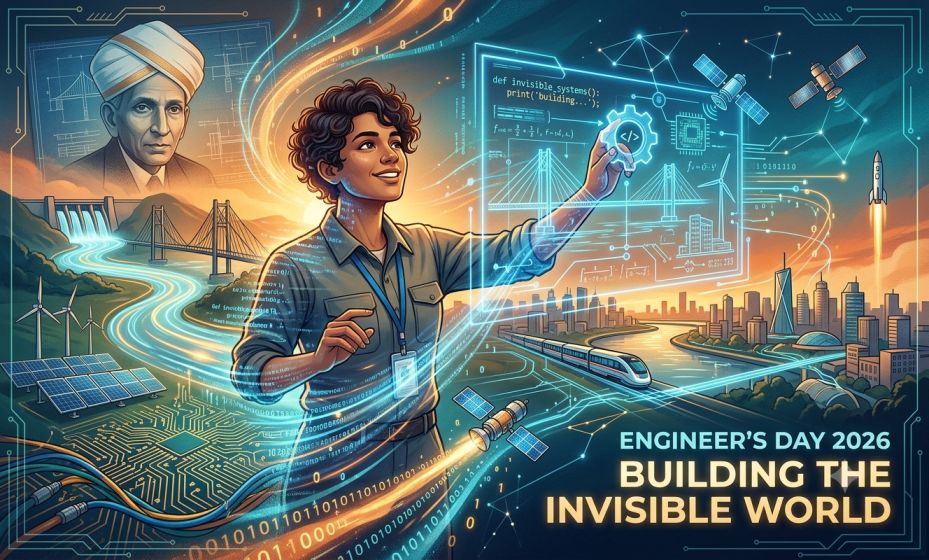
Every year on September 15, India
pauses to commemorate National Engineer’s Day—a date chosen to honor the birth
anniversary of Sir Mokshagundam Visvesvaraya. Known fondly as Sir M.
Visvesvaraya, he was a visionary civil engineer, statesman, and educator whose
work transformed the infrastructure landscape of modern India. From designing
intricate flood protection systems to engineering the Krishna Raja Sagara dam,
his legacy serves as a timeless reminder of what true innovation looks like.
Yet, beyond paying homage to
historical icons, Engineer’s Day offers us a compelling moment to reflect on a
fundamental question: What does it really mean to be an engineer today?
Beyond the Blueprint: The Quiet
Force Behind Modern Life
When we think of engineering, our minds
often gravitate toward massive physical structures—soaring bridges, sprawling
road networks, high-rise skyscrapers, or heavy industrial machinery. While
these physical marvels remain central to human civilization, the scope of
engineering has expanded into almost every aspect of daily life.
Today’s engineers build the unseen
foundation of the modern world:
Engineers are, above all else,
systematic problem solvers. They take complex, messy challenges and break them
down into functional, scalable, and elegant solutions.
The Art of Engineering: Logic Meets
Creativity
There is a common misconception that
engineering is purely mathematical, cold, and rigid. In reality, modern engineering
is deeply creative.
Writing clean, scalable code or
designing an optimized database schema requires an artistic balance between
structural rigor and creative design. Designing efficient system architectures
means anticipating how users will interact with a product, managing hardware
constraints, and writing code that is not only functional, but maintainable for
years to come.
Whether it is optimizing server
response times, configuring local virtual machines, or fine-tuning hardware
parameters for peak efficiency, the spirit of engineering remains the same:
finding a better, smarter, and more efficient way to do things.
Learning to Adapt: The Continuous
Journey
Perhaps the defining characteristic
of the engineering mindset is adaptability. Technology evolves at a relentless
pace. Programming paradigms shift, hardware architectures mature, and new tools
constantly emerge to replace old standards.
For engineers across every
discipline, learning never truly stops. The ability to embrace new frameworks,
debug unexpected system behavior, and continuously upgrade one's skill set is
what sets successful problem solvers apart. It is a field built on trial and
error, continuous iteration, and the resilience to keep troubleshooting until
the system works seamlessly.
Looking Ahead: Engineering for the
Next Generation
As we navigate an era defined by
rapid automation, artificial intelligence, renewable energy initiatives, and
expanding digital ecosystems, the role of the engineer is evolving faster than
ever before.
The challenges of tomorrow will
require not just technical competence, but ethical responsibility, sustainable
design principles, and cross-disciplinary collaboration. Whether building
sustainable urban infrastructure, writing secure software, or advancing automation,
engineers will remain at the forefront of shaping how society lives, works, and
interacts.
A Moment of Appreciation
To every engineer, developer,
technician, architect, and problem-solver who works behind the scenes—often
spending late nights debugging code, optimizing performance, or fine-tuning
systems—Happy Engineer’s Day.
Your work shapes the invisible
infrastructure that makes modern life possible.