Breaking News




Popular News





Enter your email address below and subscribe to our newsletter
 By Mohit Kumar Nirwan
When we use a computer, we interact with applications, websites, games, and files without usually thinking about what makes everything work together. Behind all of these activities is the operating system, which manages the computer's hardware, software, memory, files, security, and other essential functions.
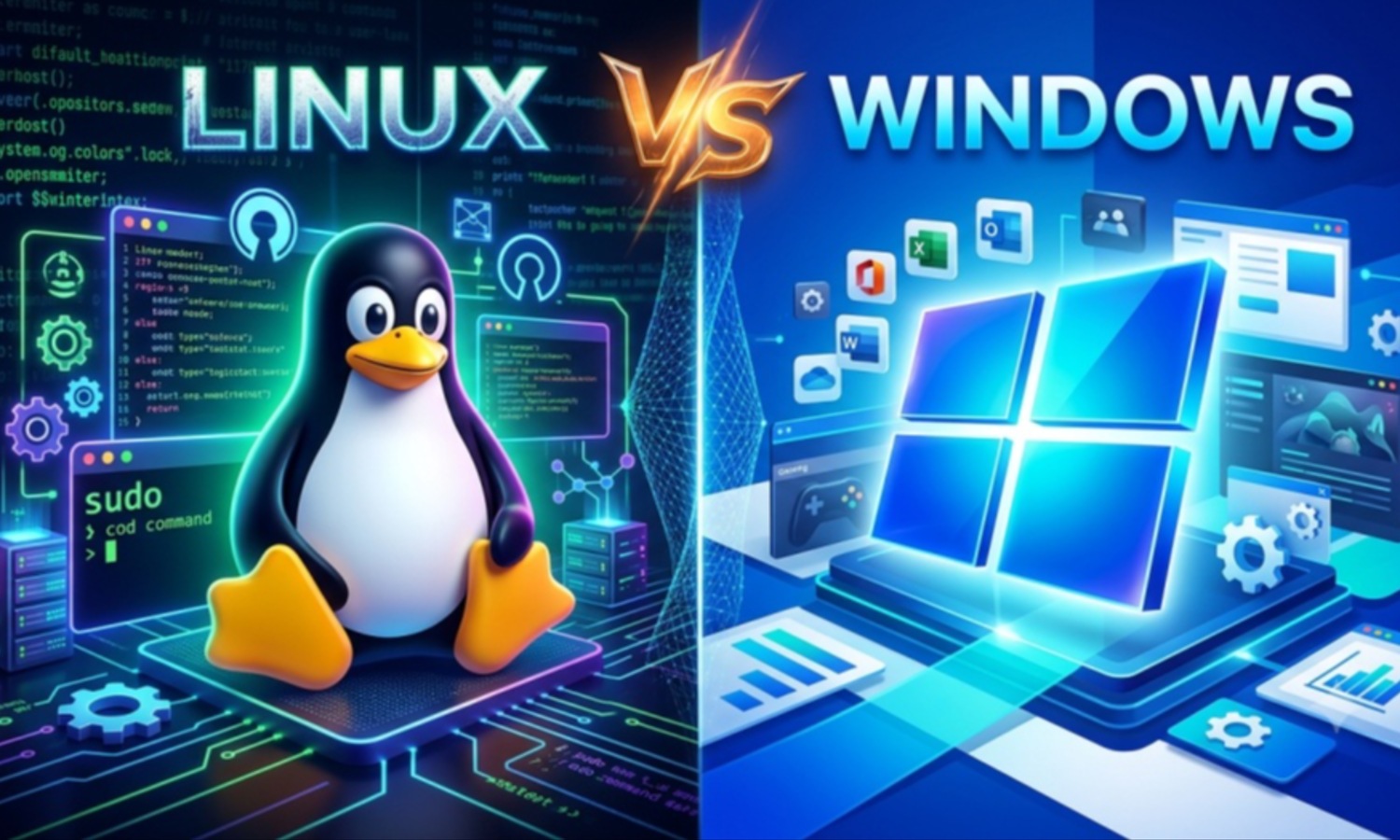
Two of the most well-known operating systems are Windows and Linux. Windows, developed by Microsoft, is widely used on personal computers, laptops, gaming systems, and business computers. Linux, on the other hand, is an open-source operating system family that is particularly popular among developers, system administrators, cybersecurity professionals, and server environments.
Although both perform the same fundamental job of managing a computer, they differ considerably in their design, flexibility, software support, security, and typical use cases.
Windows has a much larger presence on traditional desktop and laptop computers. According to StatCounter's worldwide desktop and tablet data for August 2026, Windows accounted for approximately 60.19% of the market, while Linux accounted for around 8.53%. These figures represent measured market share rather than an exact count of individual users.
However, the picture changes significantly when we look at websites and server infrastructure. According to W3Techs data from September 2026, Linux was used by 62.6% of websites where the operating system was known, compared with 8.1% for Windows.
This difference is important because it shows that desktop popularity does not tell the entire story. Windows is extremely common on personal computers, while Linux has a much stronger presence in the infrastructure that powers websites, cloud services, servers, and many other technologies.
Windows is a family of operating systems developed by Microsoft. It was designed to provide users with a graphical environment where they can easily open applications, manage files, connect hardware, browse the internet, and perform everyday tasks.
Windows is commonly found on desktop computers and laptops and is also widely used in businesses and educational institutions. Its popularity is partly due to its extensive software ecosystem and compatibility with a large variety of hardware.
Applications for office work, professional design, accounting, engineering, education, gaming, and many other purposes are available for Windows. Since many computers are also sold with Windows already installed, new users often become familiar with it without having to make an operating-system choice themselves.
Linux is an open-source operating system built around the Linux kernel. Unlike Windows, Linux is available through many different distributions, commonly called distros. Each distribution can provide a different combination of software, desktop environment, configuration tools, and package-management systems.
Some well-known Linux distributions include Ubuntu, Linux Mint, Fedora, Debian, Arch Linux, and Kali Linux.
Linux is widely used in servers, cloud computing, software development, networking, cybersecurity, and embedded systems. It is also available as a desktop operating system and can provide a highly customizable environment for personal computers.
One of Linux's biggest differences from Windows is the amount of control it gives users. Experienced users can change many parts of the system and configure it according to their requirements.
Windows has traditionally focused on making everyday computer tasks accessible through a graphical interface. Installing software, managing files, changing settings, connecting devices, and performing common tasks can generally be done without using the command line.
Modern Linux distributions have also become considerably easier to use. Distributions such as Ubuntu and Linux Mint provide graphical interfaces that make many everyday tasks straightforward.
However, Linux users are more likely to work with the terminal. Commands can be used to install software, manage files, configure services, monitor processes, and perform administrative tasks. Although this can initially seem difficult to beginners, it becomes a powerful tool once users become familiar with it.
The performance of an operating system depends on several factors, including hardware, software, drivers, and system configuration.
Windows can perform very well on modern computers, particularly when the system has sufficient hardware resources. Linux, however, offers many lightweight distributions that are designed to work efficiently on older or less powerful computers.
This makes Linux an interesting option for users who want to continue using older hardware rather than replacing it. However, it would be incorrect to say that Linux is always faster than Windows. Performance varies depending on the particular Linux distribution, desktop environment, applications, and hardware being used.
Security is another area where Windows and Linux are frequently compared. Both operating systems provide security features and both can be secure when they are properly configured and maintained.
Linux uses a strong permission system that separates normal users from administrative privileges. Its open-source nature also allows developers and security researchers to examine its source code.
Windows includes its own range of security technologies, including Microsoft Defender, Windows Firewall, Secure Boot, BitLocker, and User Account Control.
The operating system itself is only one part of computer security. Weak passwords, outdated software, phishing attacks, malicious downloads, excessive privileges, and poor configuration can create security problems on either platform. Keeping the operating system and applications updated is therefore important regardless of which system is being used.
Software compatibility is one of Windows' major strengths. A huge number of commercial applications are developed specifically for Windows, including business software, professional applications, engineering tools, creative software, and games.
Linux also has a large software ecosystem, particularly for programming, system administration, networking, and open-source applications. However, some proprietary Windows applications do not have native Linux versions. In such cases, Linux users may need to use alternative software or compatibility technologies.
For developers, Linux can be particularly convenient because many popular development tools and technologies are designed to work naturally in Linux environments. Git, Docker, Python, Java, databases, SSH, and many cloud technologies are commonly used on Linux.
Windows has also become increasingly attractive to developers through tools such as Visual Studio, Visual Studio Code, PowerShell, Docker, and Windows Subsystem for Linux (WSL).
Windows has traditionally been the dominant operating system for PC gaming. A large number of games are developed primarily for Windows, and the platform has extensive support for graphics cards, gaming peripherals, launchers, and anti-cheat technologies.
Linux gaming has improved significantly in recent years. Technologies such as Steam's Proton compatibility layer allow many Windows games to run on Linux.
However, compatibility can still vary from one game to another. Some games may have problems related to anti-cheat systems, DRM, launchers, or other Windows-specific technologies. Gamers should therefore check whether their particular games are supported before moving to Linux.
Linux provides a much greater degree of customization than Windows. Users can choose different desktop environments, window managers, themes, file managers, terminals, and other system components.
Popular Linux desktop environments include GNOME, KDE Plasma, Xfce, and Cinnamon. This means that two computers running Linux can look and behave very differently depending on how they are configured.
Windows provides customization options such as themes, wallpapers, colors, taskbar settings, and accessibility features, but it generally maintains a more standardized desktop experience.
One of the most interesting differences between the two operating systems becomes visible when we move away from personal computers and look at servers.
Linux has a very strong presence in web servers, cloud computing, containers, development environments, networking systems, and other infrastructure. The W3Techs data mentioned earlier shows this clearly, with Linux accounting for 62.6% of websites where the operating system was identifiable in September 2026, compared with 8.1% for Windows.
Windows Server is also widely used, particularly in organizations that depend on Microsoft's enterprise technologies such as Active Directory, IIS, and Microsoft SQL Server.
This means that a person may be using Windows on their laptop while accessing a website or online service that is running on a Linux server somewhere else in the world.
Another difference is the way the two operating systems are distributed.
Many Linux distributions can be downloaded and used without purchasing a traditional desktop operating-system license. This makes Linux attractive to students, developers, hobbyists, organizations, and server administrators.
Windows is a commercial operating system and is commonly distributed through computer manufacturers, retail licenses, and organizational licensing programs.
However, the cost of an operating system is only one part of the overall cost of running a computer. Software licenses, technical support, maintenance, training, hardware, and administration can all contribute to the total cost.
The choice between Linux and Windows depends largely on what you expect from your computer.
Windows can be a practical choice for users who need specific Windows software, play PC games, use specialized commercial applications, or want broad hardware and software compatibility. It is also a common choice in workplaces where Microsoft technologies are already part of the organization's infrastructure.
Linux can be attractive to users who want an open-source system, extensive customization, a powerful command-line environment, or an operating system for programming, servers, networking, and cybersecurity. It can also be useful for people who want to learn more about how operating systems actually work.
There is also no requirement to choose only one. Users can run Linux and Windows on the same computer through dual booting, virtualization, or technologies such as Windows Subsystem for Linux.
Linux and Windows have developed into two very different but important parts of the computing world. Windows has a much larger presence on desktop and laptop computers, while Linux plays a major role in servers, cloud infrastructure, development, networking, and cybersecurity.
The statistics demonstrate this difference clearly. StatCounter reported Windows at approximately 60.19% of worldwide desktop and tablet operating-system market share in August 2026, compared with 8.53% for Linux. At the same time, W3Techs reported Linux on 62.6% of websites with a known operating system, compared with 8.1% for Windows in September 2026.
Rather than viewing Linux and Windows as direct replacements for one another, it is more useful to understand where each operating system is commonly used and what strengths it provides. Windows remains a major part of everyday personal and business computing, while Linux quietly powers a huge amount of the technology that operates behind the scenes.
For anyone interested in computers, programming, networking, or cybersecurity, understanding both operating systems can provide a much broader picture of how modern computing works.