Breaking News



Popular News




Enter your email address below and subscribe to our newsletter
 By Mantripat Singh
Imagine finishing a task that once took three hours in just thirty minutes. At first, it sounds like freedom. More time for yourself. Less pressure. Maybe even shorter working days.
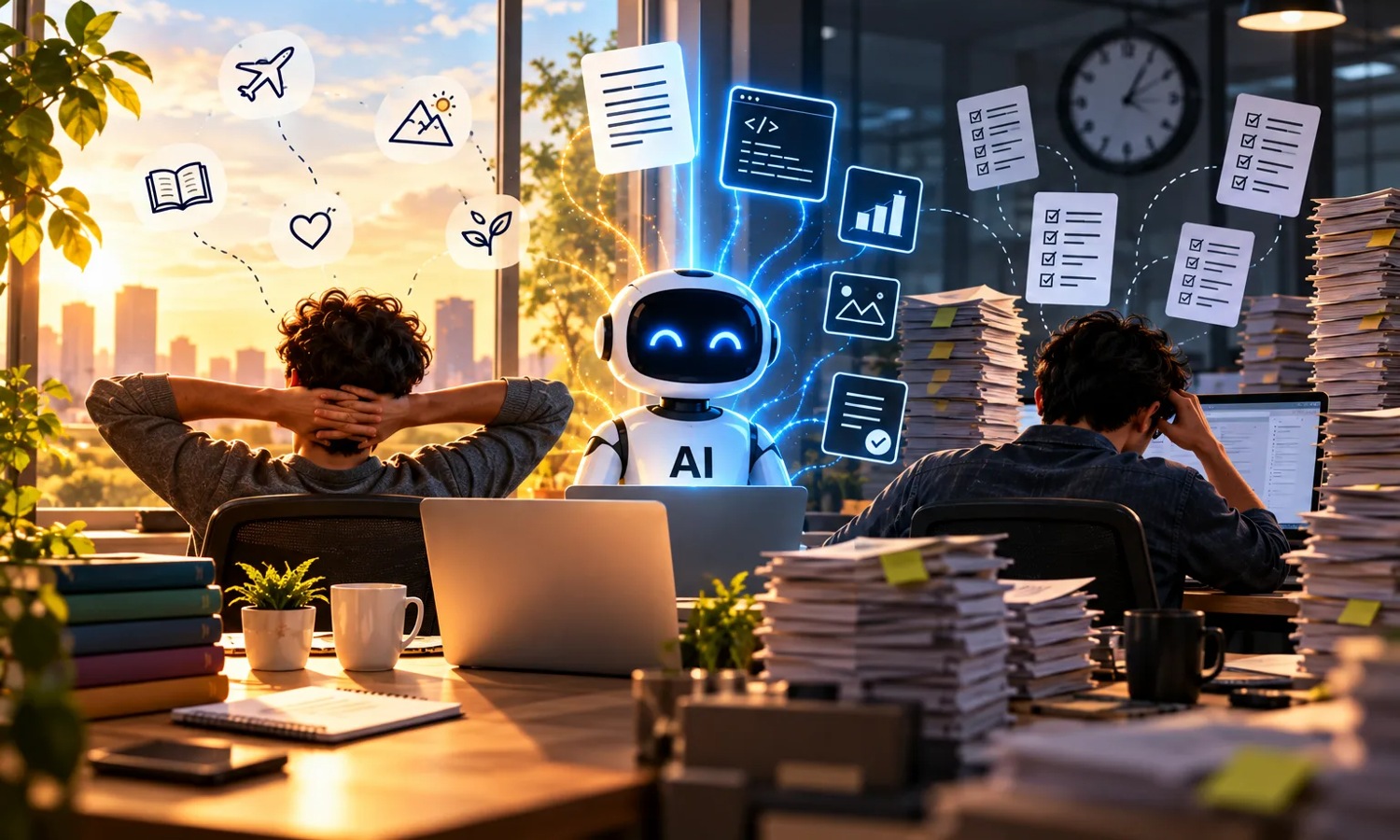
But there is another possibility: what if that thirty-minute task simply becomes the reason you are given six more?
AI is changing how quickly many kinds of work can be completed. Writing, coding, research, data analysis, design, and customer support can all be assisted by AI.
So a simple question follows: if technology helps us finish work faster, why should we continue working for the same number of hours?
Technology has made many individual tasks faster over the years, but that has not always meant shorter working days. Sometimes, it has simply meant that more can be expected within the same amount of time.
AI could follow the same pattern.
Suppose a report once took two days. With AI, you can finish it in half a day.
Your first thought might be:
“Great. I have more free time.”
But your workplace might eventually think:
“If it takes half a day now, perhaps we can expect four reports instead of one.”
The technology has not necessarily reduced the workload. It has changed what can be expected from the same working hours. And once faster becomes normal, yesterday's speed can start looking slow.
AI can generate ten drafts in the time it once took to create one. But someone still needs to review them, make decisions, communicate with others, and take responsibility for the final result.
This creates a gap between what technology makes possible and what people are expected to deliver.
If the focus remains only on output, the time AI saves could quickly become additional expectations rather than additional personal time.
There is another possibility. Organizations could treat the time saved by AI as something employees actually get back.
Fewer unnecessary meetings. More flexibility. Shorter working days. More time for learning, creativity, or life outside work.
But AI cannot make that decision for us. It can make a task faster. It cannot decide what we should do with the time we save.
Perhaps the real question isn't whether AI will reduce working hours.
It is: Who gets to decide what happens to the time AI saves?
Companies may use it to increase output. Workers may use it to reduce repetitive work. Individuals may simply want more time away from work.
The technology creates the possibility. How that possibility changes our working lives will depend on the choices made around it. And that may become one of the defining questions of the AI era:
When machines make us faster, will we finally have more time—or will “faster” simply become the new minimum?