Breaking News




Popular News





Enter your email address below and subscribe to our newsletter
 By Mantripat Singh
Most of us get internet through a fiber cable, broadband connection, or mobile network. But what if there is no fiber cable in your area and the mobile network is unreliable? This is the problem Starlink is trying to solve. Instead of bringing internet through cables all the way to your home, Starlink delivers internet using thousands of satellites orbiting Earth.
Starlink is a satellite internet service developed by SpaceX, the aerospace company founded by Elon Musk in 2002. The basic idea is simple: a Starlink dish at your home communicates with satellites in Low Earth Orbit (LEO), and those satellites connect your request to Starlink's network and the wider internet.
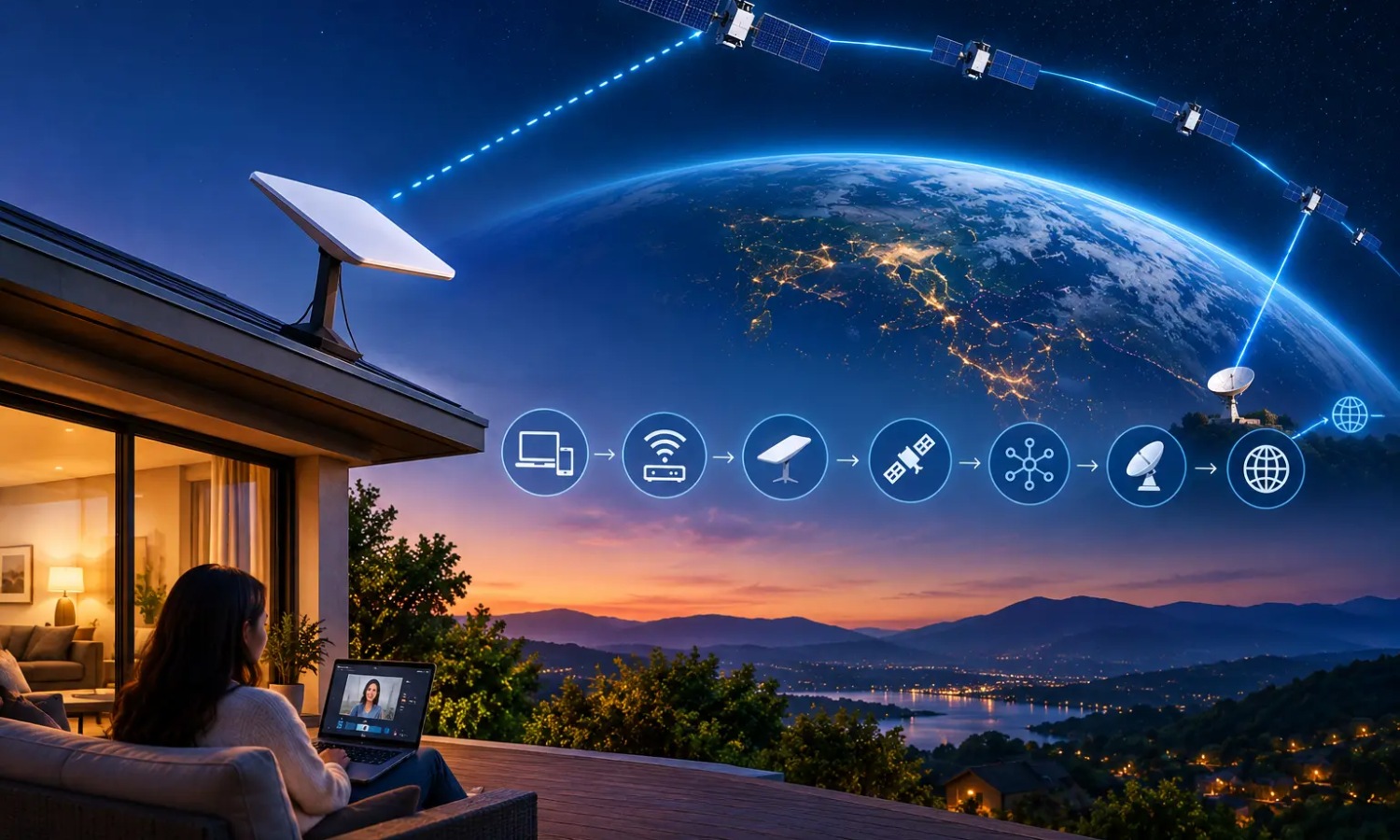
The basic connection can be understood like this:
Your Device → Wi-Fi Router → Starlink Dish → Starlink Satellite → Starlink Network → Ground Station → Internet.
When you open a website or watch a video, your request travels from your device to the router, then to the Starlink dish, up to a satellite, through the Starlink network and eventually to an internet-connected ground station. The response comes back through the network to your dish and then to your device.
Unlike traditional satellite internet, Starlink satellites operate much closer to Earth, generally around 550 km above the surface. Traditional geostationary satellites are around 35,786 km away. Because Starlink's satellites are much closer, the signal has a much shorter journey, which helps provide significantly lower latency.
A single satellite cannot provide continuous coverage everywhere because it is constantly moving across the sky. Starlink solves this by using a large constellation of satellites. As one satellite moves away, another satellite can take over the connection, similar to how your phone switches between mobile towers while you are travelling.
As of October 2026, SpaceX says it has more than 11,000 Starlink satellites in low Earth orbit, and the company has plans to expand the constellation much further. This huge number is one of the most important parts of the Starlink system because it allows the network to provide wider coverage and maintain connections as satellites move overhead.
Another interesting part is that Starlink satellites can communicate with each other using optical laser links. This means data does not always have to travel directly from a satellite to a nearby ground station. It can move between satellites before reaching the ground, creating something similar to an internet network in space.
Starlink's typical service can provide download speeds from roughly 25 Mbps to more than 200 Mbps, depending on the plan, location and network conditions. Land-based services generally have latency around 25–60 ms, although actual performance can vary.
Starlink is no longer focused only on connecting homes in remote areas. The company is expanding into aviation, maritime connectivity and mobile communication. Its Direct to Cell technology aims to allow compatible mobile phones to connect directly to Starlink satellites, without requiring a traditional cellular tower nearby.
The idea is similar to putting a mobile tower in space. Instead of your phone communicating with a tower on the ground, it can communicate with a satellite overhead. This could become especially useful in remote areas, during emergencies and in places where traditional mobile infrastructure is difficult to build.
Starlink is also expanding its availability around the world and is already serving more than 160 markets and territories. At the same time, SpaceX continues investing heavily in rockets, satellites and network infrastructure. This gives Starlink an unusual advantage: SpaceX can build the rockets, launch the satellites and operate the internet network itself.
Starlink is not automatically better than fiber. If you already have a good fiber connection, fiber will usually provide higher and more consistent speeds, lower latency and better reliability.
The real advantage of Starlink is where traditional infrastructure is difficult or expensive to build. A fiber cable may take years of infrastructure work to reach a remote village, mountain area or isolated location. A Starlink dish can potentially provide connectivity much faster without requiring a physical cable to reach the property.
That is what makes Starlink interesting. It is not simply trying to replace every fiber connection. It is creating another way to connect people to the internet — by building part of the internet above us in space.
Thousands of moving satellites, laser connections, ground stations, rockets and software are working together to create an internet infrastructure that surrounds the Earth.
For many people, the future of internet connectivity may not always require a cable running to their home. Sometimes, the connection could simply come from the sky.